Along the borderline between Mexico and the United States by Frida Kahlo
Frida Kahlo painted the border not as a line on a map but as a wound running through identity itself. A close reading of her 1932 canvas and what it means to exist between two worlds that refuse to hold you.
✦ Table of Contents
The juxtaposition of Mexico and United States in the painting fascinated me at first glance for its representative quality. I loved the painting because of the little details such as the roots of the vegetation and the label of Ford. In general, the painting can be divided vertically, Kahlo herself representing the dividend. On the left side, the sun and moon are in the firmament in their clouds, whose interaction causes a lightning and also the left side features a ruined temple below which are some flowers, all representing Mexico. As for the right side, there is a cloud coming from a factory of Ford, along with some mechanical devices painted below. The cloud contains the flag of the United States with its stars against the moon and the sun on the left side. All of those represent the industrialization of the United States, which is presented as a negative feature.
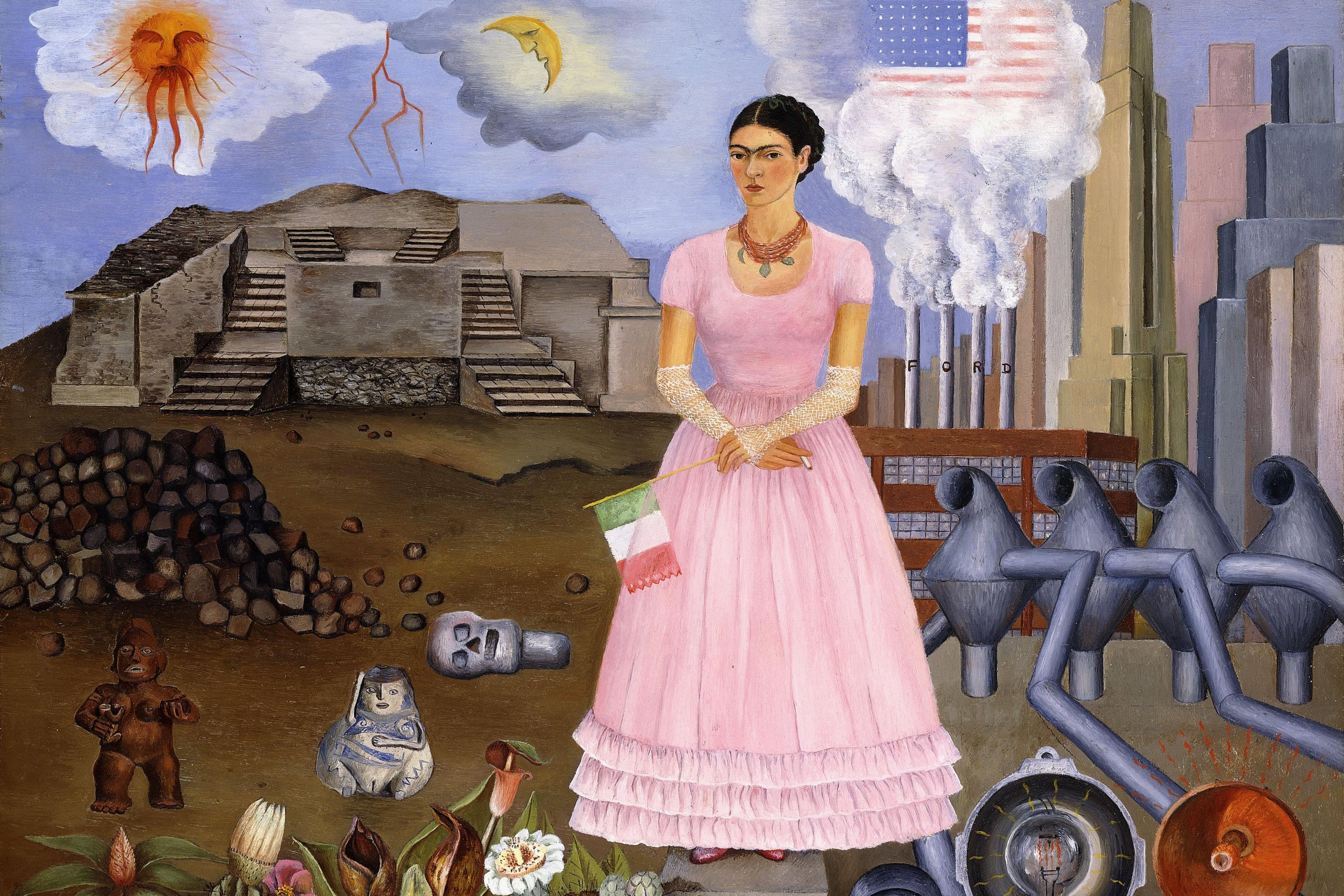
The painting is a self-reflection of Kahlo herself who adores her country Mexico with its authentic nature and never-ending cycle of life and death, which where symbolized by the Aztec temple, the skull, and the idols on the left side of the painting. On the contrary, the left side has so much to do with her place of residence, Detroit, which is the center of Automobile Industry in the United States which should have affected her deeply in a negative manner. “The painting, besides capturing Kahlo’s iconic features, reflects some of her deepest concerns during that time pertaining to her political stance, cultural identity, and well-being, specifically her pregnancy.” (Ma, 1)
The painting features a well-established balance between surrealism and indigenouspainting. First of all, the sun and the moon with their faces are represented in a surrealist way which defy the nature. Also, the usage of mythological, religious, or antic figures are known the be common in her surrealist paintings. For example, according to the Journal of Surrealism and the Americas, Kahlo’s What the Water Gave was exemplary of her surrealism. In this work traditional and ancient iconography, mythology and symbolism, eroticism, and botany, are all mapped out onto the legs of a female (Kahlo, as signified by her wounded right foot), who is submerged in bath water. (Mahon, 1) The vegetation and flowers, the sculptures and idols and the representation of nature are all examples of indigenous art.
Another topic to mention is the effect of her husband on her as a famous artist. It is even evident in the fact she was first exhibited as Mrs. Diego Riviera that she was under the shadow of her husband. In the painting, there are some clues about this fact as well. The borderline which separates Mexico and United States is has an inscription stating, “Carmen Rivera painted her portrait in 1932.” She chose her Christian name Carmen but still used the last name of her husband, which is where the irony lies.
I can safely state that this painting is valuable and important for various reasons. Firstly, from an artistic perspective, it contains many elements of surrealist and indigenous painting, which contribute the art itself. Also, from a feminist reading, the fact that she uses herself as her subject shows the discrimination that women had no chance to use models whereas male painters could use both male and female models back in the 19th century France. From a political reading, we could interpret this painting an indicator of our time given the situation between Mexica and the United States. Lastly, a Marxist reading would also yield interesting outcomes as for the fraternity of nations and the industrialization. Shortly, in every kind of interpretation, this painting produces valuable outcomes that can be used to improve societies in general and ourselves in particular.
References
Kahlo, Frida. Self-Portrait on the Borderline between Mexico and the United States. 1932, Philadelphia Museum of Art, United States.
LATHERS, MARIE. “The Social Construction and Deconstruction of the Female Model in 19th-Century France.” Mosaic: An Interdisciplinary Critical Journal, vol. 29, no. 2, University of Manitoba, 1996, pp. 23–52.
Ma, Leyuan. “Frida Kahlo’s Self-Identity: An Analysis of Self-Portrait on the Borderline
between Mexico and the United States.” Int’l J. Soc. Sci. Stud. 8 (2020): 10.
Mahon, Alyce. “The Lost Secret: Frida Kahlo and the Surrealist Imaginary.” (2011).